


The month in one glance
20 deals logged. $105.56 billion in disclosed one-time capital commitments (power purchase agreements and the Google–SpaceX monthly lease isn’t counted as one-time capital).
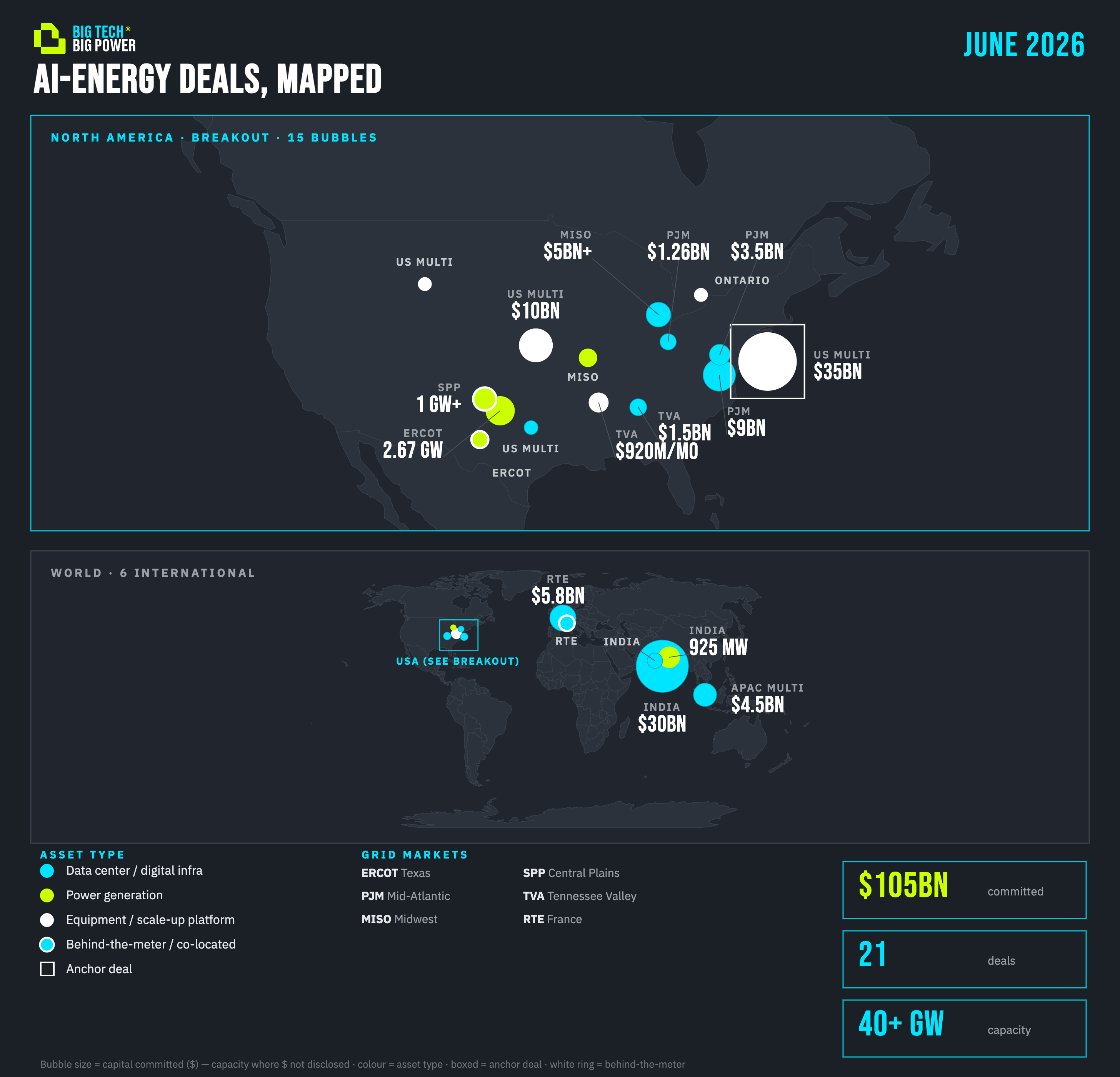
Where it concentrated: Texas and the US grid markets drew the most activity; India saw the single largest multi-year commitment ($30bn, AirTrunk); France had two campuses on former power-plant sites. Two deals bypassed the public grid entirely — built behind-the-meter, next to their own power.
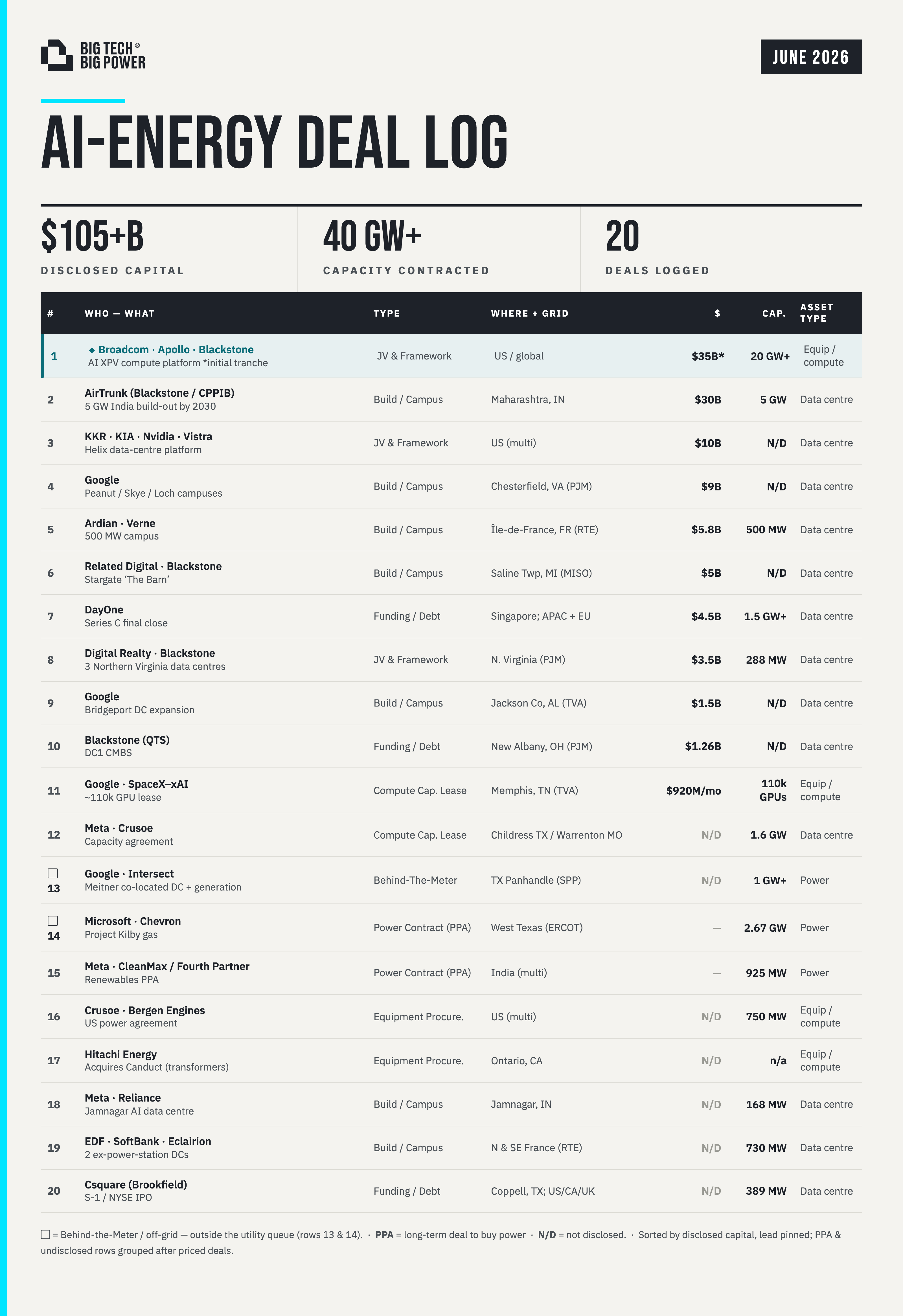
The lead: a platform that finances AI chips like real estate
In June, Broadcom, Apollo, and Blackstone announced a $35 billion platform to finance more than 20 gigawatts of custom AI computing through 2028; the first money funds an expansion for Anthropic (Apollo). It buys Broadcom XPUs — custom AI chips built to one customer’s exact design (unlike a GPU, which anyone can buy off the shelf) and makes that computing power available to frontier labs, named as Anthropic and OpenAI. The notable part is who’s funding it: Apollo and Blackstone through their credit and insurance arms, not a traditional venture fund.
How is works? Long-dated capital, the money behind insurance policies and credit funds pays for the chips up front. The labs commit to pay for the computing power over several years, and those commitments are what the financing rests on. The chip stops being something a lab buys and writes off and becomes an asset a pool of capital owns and gets paid back on over time, closer to how a building or a fleet of aircraft gets funded.
Why it’s worth noticing: for two years the constraint on AI has been physical; power, grid, buildings. This points to a financial constraint: how you fund chips that lose value every year. And the capital being tapped isn’t venture money; it’s insurance and credit.
The open question is whether AI chips make good collateral. A building holds value for decades; a top-end AI chip can be outclassed in a few years. So the structure leans less on the resale value of the hardware and more on the labs’ commitment to keep paying.
Intelligence layer
Verse raised $54M in June 2026, strengthening investment in growth-stage software startups building in this layer — using AI to find grid capacity, forecast demand, or manage on-site power. These are venture-scale rounds ($5–70M). Verse’s $54M in June follows GridCARE’s $64M in May, Emerald AI’s $25M in March, and Amperon’s Series B in January.
Verse’s Dispatch Intelligence manages a data center’s on-site solar and batteries and schedules when the site draws from the grid, allowing it to operate sooner rather than waiting in the interconnection queue (the multi-year line to connect a large load to the grid).
Software-scale startups at the AI/energy intersection are small relative to the physical infrastructure deals — generation and data-center capacity, funded in the hundreds of millions to billions (in June, roughly $1.3bn to $35bn). Both address the same constraint — the multi-year wait to connect a data center to the grid.
The more useful detail is the investor set. Verse’s round was led by Bessemer, with GV and NVIDIA participating. NVIDIA is also an integration partner: it is incorporating Verse’s software into its DSX AI Factory reference design for data-center builders.
The implication is straightforward. NVIDIA is treating the grid connection, not chip supply, as a key constraint, and is addressing it in the software layer as well as through hardware. Tracking which strategic investors recur across these rounds is a way to see where the constraint — and the value — is moving.
Quick explainers
XPU = a custom AI chip built for one customer’s specific work (a GPU, by contrast, is a general chip anyone can buy).
Gigawatt (GW) = a unit of power; one gigawatt is roughly enough to power a mid-sized city. “20GW of compute” means data centers drawing about that much electricity.
Behind-the-meter (⚡) = a data center wired straight to its own power plant, skipping the public grid.
PPA (power purchase agreement) = a long-term deal to buy electricity from one supplier.
CMBS = a bond backed by commercial property — here, income from a data center.
Grid markets (ERCOT = Texas; PJM = Mid-Atlantic; MISO = Midwest; SPP = central plains; TVA = Tennessee Valley; RTE = France) = the regional operators that run the power grid.
Sources
All 20 June deals, in log order:
Broadcom + Apollo + Blackstone — Apollo
KKR / Helix Digital Infrastructure — Data Center Dynamics
Ardian + Verne — Ardian
DayOne Data Centers — PR Newswire
Related Digital + Blackstone (Stargate “The Barn”) — Oracle
Meta + Reliance (India DC) — Meta
Meta + CleanMax / Fourth Partner (renewables) — Meta
Crusoe + Bergen Engines — Crusoe
Hitachi Energy / Canduct — Hitachi Energy
Google + SpaceX/xAI (compute lease) — Data Center Dynamics
Csquare IPO — The Deal
AirTrunk (India) — Forbes
Google + Intersect (Meitner, BTM) — POWER Magazine
Microsoft + Chevron (Project Kilby, BTM) — TechCrunch
Google (Chesterfield, VA) — VPM
Digital Realty + Blackstone (NoVa) — Yahoo Finance
Google (Bridgeport, AL) — AL Daily News
Blackstone / QTS (CMBS) — CoStar
EDF + SoftBank + Eclairion (France) — Data Center Dynamics
Meta + Crusoe (compute capacity) — Data Center Dynamics